Balance & Movement Disorders Care at NeuroAxis Health
Restoring Confidence, Independence, and Control
Balance and movement disorders can affect daily life, from walking across a room to enjoying time with family. These conditions often stem from disruptions in the brain’s sensory-motor systems, which control movement, posture, and coordination.
At NeuroAxis Health, we combine functional neurology, neurorehabilitation, and evidence-based neurotherapies to provide comprehensive care. With nearly 20 years of experience, Dr. Rachman Chung leads one of the San Francisco Bay Area’s most trusted programs, supported by Dr. Jessica Tolentino’s expertise in neurofeedback and qEEG-guided therapies.
Our goal is to help you move with greater stability and confidence while supporting long-term function and quality of life.
A progressive brain disease marked by shaking tremor, muscle stiffness, slowed movement, and non-motor symptoms such as loss of smell, constipation, anxiety and depression.
Essential Tremor
A condition causing rhythmic shaking, usually in the hands, head, or voice, especially while doing simple tasks.
Ataxia
Loss of coordination and balance, causing clumsy movements and unsteady walking; can stem from brain injury, genetics, stroke or neurodegenerative changes.
Dystonia
Involuntary muscle contractions lead to twisting movements or repetitive postures, sometimes affecting the neck, extremities, or entire body.
Chorea and Huntington’s Disease
Chorea causes sudden, brief, jerky movements or dance-type movements. These are often genetic or caused by infection.
Vertigo and Vestibular Disorders
DIzziness can result from disrupted sensory pathways within the brain related to vision, memory, and balance systems from injury, infection or neurodegeneration.
Restless Legs Syndrome
Uncomfortable feelings in the legs and an urge to move, usually worse at night.
Multiple System Atrophy and Progressive Supranuclear Palsy
Rare disorders with symptoms similar to Parkinson’s, but more progressive.
Tardive Dyskinesia
Tardive dyskinesia involves repetitive, involuntary movements, often from long-term medication use.
Myoclonus
Sudden, brief, involuntary twitching or jerking of a muscle or group of muscles.
Hope for Improvement
While many balance and movement disorders are ongoing or get worse over time, new advances with neurotherapy and rehabilitation strategies can help improve mobility, decrease symptoms, and enhance quality of life.
The Functional Neurology Evaluation
Every care plan begins with our Functional Neurology Evaluation, which measures how your brain processes sensory, motor, and cognitive information. This helps us identify the root causes of symptoms and create a personalized rehabilitation plan.
Our evaluation examines seven key areas of brain and body function:
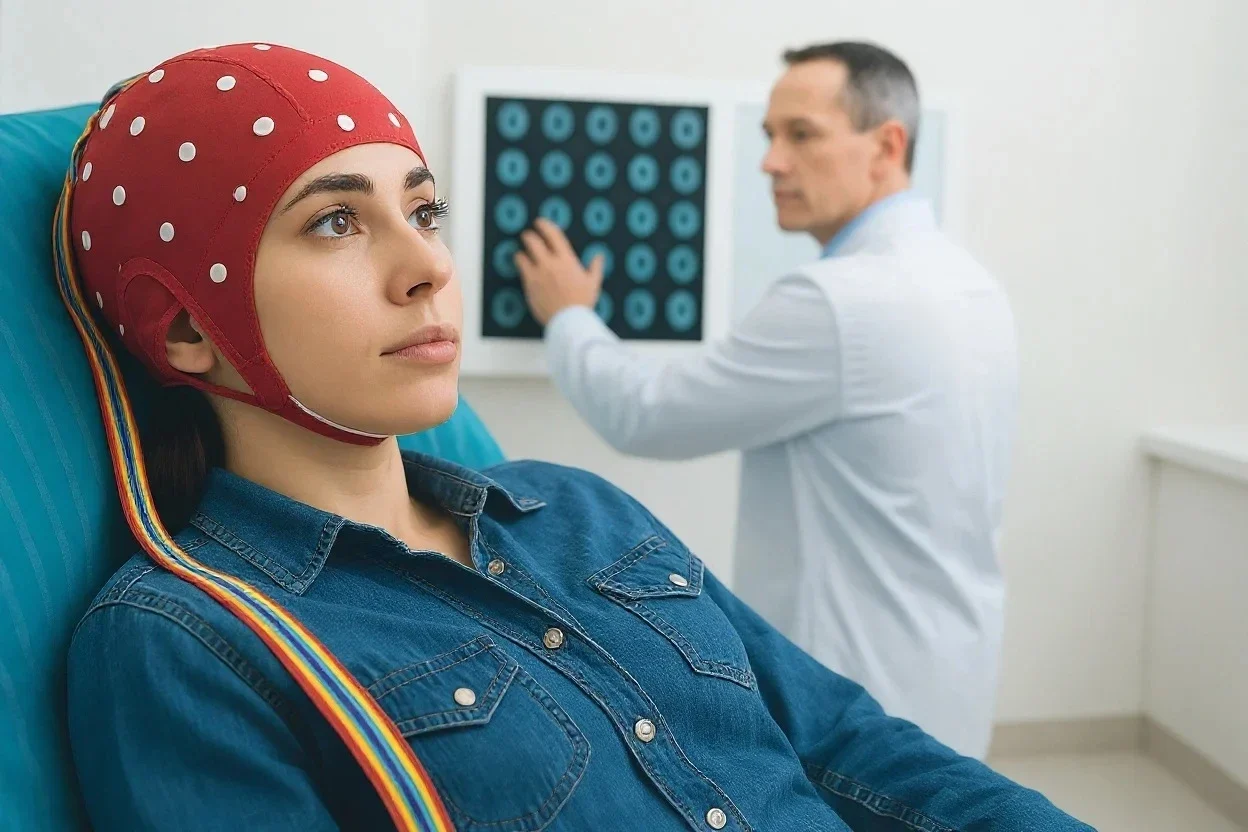
Brainwaves (qEEG): Identifies regions functioning too slow, too fast, or inefficiently.
While many balance and movement disorders are chronic or progressive over time, new advances in neurotherapy and rehabilitation offer renewed hope to help improve function and quality of life. Our approach can help patients with:
Patients choose NeuroAxis Health because we offer both advanced diagnostics and personalized rehabilitation. Our team is trusted by neurologists, primary care providers, and mental health specialists throughout the Bay Area for complex cases.
What sets us apart:
Nearly 20 years of clinical experience in balance and movement disorders
Comprehensive evaluations that uncover root causes of symptoms
Integrated therapies that support both brain recovery and physical function
Collaborative care with your broader medical team
A focus on restoring independence and quality of life
At NeuroAxis Health, we are committed to walking with you every step of the way, helping you heal, strengthen, and thrive with care that unites compassion and scien
Living with a balance or movement disorder can feel overwhelming, but you don’t have to face it alone. Our Functional Neurology and Neurotherapy programs give you a clear path to optimize your function, preserve independence, and improve quality of life.
➡ Schedule your Functional Neurology Evaluation today and take the first step toward
Our patients share their success stories, highlighting the compassionate care, expert treatment, and lasting results they’ve experienced at NeuroAxis Health in San Francisco.
What a godsend! I had been suffering near constant debilitating migraines from a car accident injury that kept getting worse. I tried steroid shots, radio frequency ablation, you name it, I was desperate to get rid of the awful pain and regain my once active life. Dr. Jesse Tolentino at NeuroAxis is a true miracle worker. Such impressive skill and very compassionate, she has changed my world with her committed care to my healing. I was a bit scared at first because I have a really tricky neck with many complications including osteoporosis. But she assured me with her experience in resolving such issues. Thank god I'm able to function normally again! I can't say enough good things about this wonderful doctor. I highly recommend going here. You will be well taken care of...
I am seeing both Dr. Tolentino and Dr. Chung for sleep issues (I wake up pretty much every hour) and migraines on occasion. My sleep patterns have improved significantly. I am now doing remote-neurofeedback and doing my treatments before bed. Training my brain to sleep through the night. So grateful for these two Docs! Sharing a picture of the BrainBit Neurofeedback Kit I use at home.
Before I went to Dr Chung, I was having imbalance issues, unable to move my eyes in certain ways without causing immediate and severe neurological issues, and plagued with insomnia and night terrors. Dr Chung's treatment was literally the ONLY thing that helped improve my symptoms.
He genuinely cares about his patients' wellbeing and is even willing to work with them on financial issues. I can't recommend him enough!
Dr. Chung is the best in the city, along with his entire staff who are all so friendly, caring, and knowledgeable! I had a horrible nerve issue that was ongoing for a year post-ankle fracture surgery, and saw 5+ doctors that couldn’t diagnose or figure out why I was having the issue. At one point it was difficult to even walk or day to day activities without feeling chronic pain. Then I saw Dr. Chung, who helped me beyond addressing the root cause - and provided a holistic and long-term treatment. My treatment included advanced red-light therapy, physical therapy, chiropractor sessions, and recommendations for lifestyle changes. He’s changed my life for the better, now living pain-free and back to a very active life - so couldn’t recommend Dr. Chung and his team more!
This is a place where healing happens. My brain and I are in a much better place than when I walked through the doors 5 1/2 months ago. Dr. Chung and Dr. Jessica know how to transform the quality of life for each and every patient. My family and friends are happy to see the new me. I’m grateful that I chose NeuroAxis Health and I hope you do too.
Dr. Chung and the team here are beyond incredible. I feel so lucky to have them helping and supporting me! Dr. Chung is very kind and knowledgeable and is great. Cannot recommend seeing him and going to the practice more!
Dr Chung was extremely attentive and caring, and had a lot of tools in his belt. I felt that he was genuinely determined to help me heal my migraines. Really quality care, and a myriad of offerings.
In just a few months, Dr. Chung has made such a difference in my life. When I came to Dr. Chung about my migraines, I was at the end of my rope. I’d tried just about every preventative pharmaceutical on the market and was still having migraines multiple times a week, usually requiring triptans for relief. Within weeks of working with Dr. Chung, I was experiencing significantly fewer migraines and today I am happy to report that I’m two months headache-free. I feel better than I ever thought possible and am working with my primary care physician to taper off preventive pharmaceuticals. I know this would not have been possible without Dr. Chung and his team.
Dr. Chung has a comprehensive, innovative, and compassionate approach to diagnostics and care -- he really tried to get to the bottom of what was causing my migraines, and then designed a customized program of treatment that included neurofeedback, chiropractic adjustments, laser and electrical stimulation, and balance and visual rehab. At each step of the process, he explained the data and science behind the process, which helped engage me in the treatment. He is and his colleague, Dr. Fox, are also incredibly kind, and it is a pleasure to work with them. I am so grateful for their work.
Dr. Chung is the reason I’m a functional human again. I had 2 serious head traumas that left me severely impaired, and he helped me heal and resume cognitive and neural functions. I was a wreck! People don’t believe me when I tell them how I was after my injuries. Forever grateful to him. Super knowledgeable, kind, patient, and overall wonderful human! I recommend him to anyone & everyone who suffered a concussion. He’s the best!!
Working with Dr. Chung has been revolutionary for my traumatic brain injury. For the last few years, I have been experiencing post-concussive symptoms related to vision, balance, and coordination. I came to Dr. Chung feeling defeated and hopeless and through his in-depth assessments, he put many of the pieces together and provided personalized treatment that targets my weaknesses. He keeps all of the details in mind when creating the exercises so that nothing is overlooked or missed. He provides his treatment with the push, persistence and understanding that I need to overcome my symptoms. If you are someone who is suffering from balance, vision issues, concussions or brain injury symptoms, Dr. Chung will provide you the right help towards recovery.
Dr. Chung is everything you’d want in a practitioner; he’s kind, knowledgeable, caring and exceptional in his skills. I originally came for migraine help (and haven’t had a single migraine since my first appointment) and am excited to continue the work on this through his very holistic and comprehensive approach (adjustments, Biofeedback and more). Last week I had a serious inflammation in my knee which completely debilitated me. Just left his office with range of motion and significant less pain after he carefully and methodically worked to uncover the source of the injury and how to relieve the pain and adjust the muscles and joints. He also sent me home equipped with gentle exercises to continue the healing. I’ve seen many practitioners in my life and so far Dr. Chung stands out in all the ways that matter when choosing a doctor.
I've been seeing Dr. Chung since July of 2016 for a lower back issue I developed nearly a decade ago playing collegiate soccer. I've seen a number of chiropractors, orthopaedists, and physical therapists in the interceding years but nothing seemed to work. However, Dr. Chung has managed to accurately diagnose and treat me. I still see Dr. Chung occasionally for routine maintenance as I can't seem to stay away from the soccer field! Dr. Chung's a personable and considerate professional and is a pleasure to work with.
I came to Dr. Chung because of an injury I sustained in a car accident. I'd been to several doctors previously who were unable to heal my injuries and I was suffering from post concussion symptoms as well as a great deal of neck and back pain.
What I liked best about working with Dr. Chung is how patient he is with me and how he takes the time to answer every single one of my questions. Healing from an injury this big can be a very scary experience but I was glad to know I was in very kind and capable hands.
I fully trust Dr. Chung, I think he cares about his patients and he is ALWAYS driven by his desire to help heal people. He came into this practice because of his own experience healing from an injury and that is helpful because it makes him empathetic since he knows how it feels to be the patient as well.
I am truly grateful to Dr. Chung for helping me through this experience and I will be revisiting him for maintenance care as long as I live in the Bay area.
Dr. Chung has helped me with several different issues. I've had problems with a fractured foot, different back problems, and a concussion.
One of the problems with my back I've had for many years . Since I've been seeing Dr. Chung my problem has cleared up completely. I'm able to do things now I could not do before without having a flare-up with my back.
Dr. Chung is comprehensive in his evaluations. He often finds areas I didn't know were not working right and I feel so much better after his treatment.
He is very kind and caring. He is a good listener and educates his patients about how you can continue to improve your health.
I've also had some cognitive issues and was beginning to withdraw from some parts my life. With Dr. Chung's help and recommendations for home self-care I'm feeling better overall.